This idea (which honestly came from Amazon Photo) has been kicking around in the back of my mind for sometime now. I've been going through my newspaper photo archives both film and digital, trashing the prints and negatives that have been damaged beyond repair, offering to give prints to those that are in the printed photos, and taking a new look at the digital files, deleting duplicates and maybe updating the editing on older files.
With over 500,000 images it's a big job (many of the days have over 10,000 images) so I will be working on just once day at a time. I am going to try, emphasis on try, because life does get in the way, of posting at least one image with the story behind the image every single day.
With luck, by the time I reach Dec 31, 2024 I will have cleaned up all the files. Or at least a large majority of them.
Where did this all start? In high school shop class over 50 years ago, and it has had an impact on my life every day since.
Remember, that original forway into the darkroom was long the day before even one hour labs. Standard was to take a roll of film down the the drug store and drop it off, and two weeks later it would be back.
And unlike today, where people take thousands of images on their phones, most families would use a single roll of film over the course of the entire year. Taking it in to be developed just before Christmas. That way there was a new roll of film in the camera for Christmas day.
Standing there in the darkroom watching that first print develop in front of my eyes was magic. Did not matter that first image quickly went from blank white paper, to seeing an image, to totally black because it had been so overexposed in the enlarger. At that moment a photographer was born.
I finished out the last few weeks of the semester in the darkroom, and then wrangled a special project where I would be using photography to illustrate poems written by the Grade Nine English class (might have been Literature - I mean it was 50 years ago). The poem that captured my attention was written by Ava Matson, and involved writing on walls. Which lead me to Writing-On-Stone provincial park which is the largest collection of native rock art in North America.

To find the writing that was suitable for illustrating the poem, I first talked with a local nature photographer Tom Willock, he had a little office in town, and I would take my photos down for him to look at and critic. His tutelage was instrumental in how quickly I developed as a photographer.
He pointed me to the Park Warden "Scotty" Shear, who not only introduced me to the uniqueness of the area, but later when I graduated gave me my first job. In the winter my time was spent painting picnic tables, pulling the vines out of the trees, hauling garbage. When it warmed up then I was cutting grass, planting trees (all those trees in the campground by the amphitheatre -I not worked on planting them, but moving irrigation pipe around to keep them watered, picking litter from the trails) and of course taking photos. With the help of a couple of cousins and a friend, we got an OFY (Opportunities for Youth) grant to develop the first interpretive program in the park.
That summer I was given the task of taking a CBC film crew that was doing a documentary on Jerry Potts around the area, and because there wasn't a lot to do in the evening, they came to our weekly slide show.
One of the crew also worked as a photo reasearcher for Reader's Digest, and they happened to be working on a book where they needed images from the area. He contacted the office saying that they should look at some of my photos.
They sent a letter saying just that and wondering if I would send them something. Well I sent them everything, breaking every rule in the book about submissions. If you are familiar with slide film, the first couple of frames are blank because of being overexposed when loading the camera, the last couple of frames are black because they never get exposed. I sent them those, I sent them the out of focus, the blurry, the you name the mistake, it was in there.
Normally with a submission like that, the first couple of images would be looked at and then the whole package sent back. But they had been told there was something in there, so they looked.
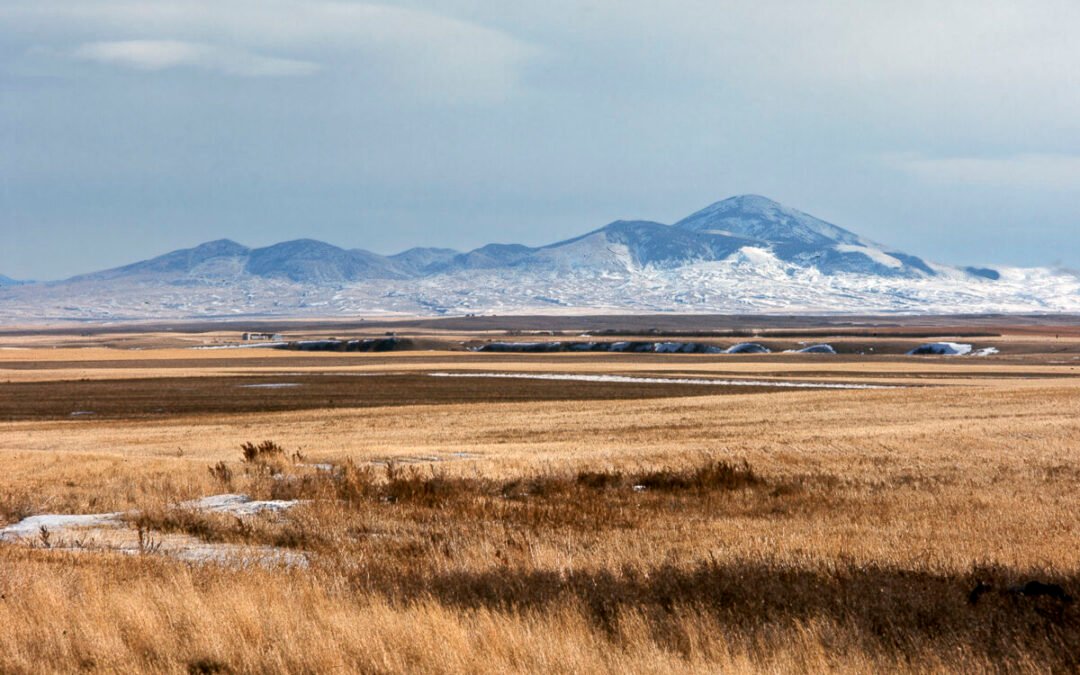
Of that original submission of over 600 slides, they kept 15, including the one at the top of the page. They also sent a letter saying that next time we ask for everything, we would prefer you did the editing on your end. That was about two years after I had originally taken the photo of the Sweetgrass Hills.